— Music —
• NOW PLAYING •
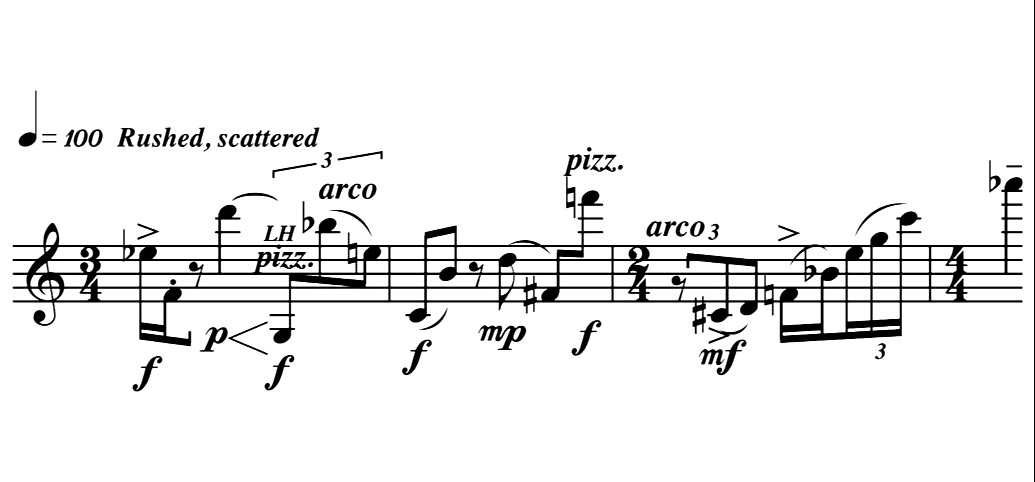
ISOLATED CRITERION NO. 4
from Isolated Criteria (2008)
Commissioned by the California Music Center for the 23rd Klein International String Competition
First performances 14 June 2008 – McKenna Theatre in San Francisco
ISOLATED CRITERION NO. 4
from Isolated Criteria (2008)
Commissioned by the California Music Center for the 23rd Klein International String Competition
First performances 14 June 2008 – McKenna Theatre in San Francisco
The music of Frank Stemper has been performed in 23 countries and two-thirds of the United States — in Carnegie Hall, The Kennedy Center, Budapest’s Pannonhalma, Vienna’s Klaviersalon Englemier, Chicago’s Symphony Center, Bucharest’s Anteil Roman, San Francisco’s Cowell Theater at Fort Mason, New York City’s Symphony Space, Milwaukee’s Performing Arts Center, etc.
It has been presented at music festivals such as The ISCM (International Society for Contemporary Music), Spain’s Festival Internacional De Musica Contemporánea, Romania’s Saptamina Internationala A Muzicii Noi, Austria’s Bregenzer Festspiele, Italy’s Festival Spaziomusica, Toronto’s Canadian League of Composers and the Canadian Music Centre, Mexico’s FESTIVAL DE MARZO and the Primer Foro de Música Nueva, Michigan State University’s Annual Symposium of New Music, the New Music Chicago Festival; at computer music festivals such as Vladmir Ussachevsky Computer Music Festival in Los Angeles, IMAGINE II Festival in Memphis, the Lewis Computer Music Festival in Chicago; and in more academic settings, such as The College Music Society, ASUC and the Society of Composers, Inc., etc., and at many universities throughout the United States.
His work has been generously supported by the National Endowment for the Arts (NEA), the Rockefeller Foundation, the Klein Competition Foundation, the American Music Center, four Artist Fellowships and a Governor’s Grant from the Illinois Arts Council, the Ragdale Foundation, Spain’s Fundación Valparaiso, Austria’s Viktorsberg Composer Institute, the New York Council on the Arts, the California Arts Council, several travel grants from Meet the Composer and MTC—Global Connections, 27 consecutive ASCAPlus awards, etc. And there have been commissions for new music – 41 so far – from orchestras, ensembles, soloists, various artistic foundations and new music societies in Western and Eastern Europe, and throughout the United States.
Among the many awards for his music are the 1981 Prix de Paris, the Hertz Prize, the Phi Kappa Phi Award for Artistic Achievement, the Arts In Celebration Commission Prize, the New York Virtuoso Singers Prize, as well as nominations from the American Academy of Art and Letters, a Grammy Award, and in 2003 his piano concerto, Secrets of War, was nominated for the Pulitzer Prize. BLUE13, a recently released recording of Stemper’s complete music for piano, performed by Korean pianist Junghwa Lee, received a Gold Medal in Global Music’s “Top 10 Albums.”
Internationally, Frank Stemper has maintained a presence on the world new music scene through a total of 15 Artist and Teaching residencies — supported by the governments of Romania, Mexico, Austria, The Netherlands, France, and Spain, and he has served as a Guest Composer at more than 50 international music festivals. In addition, there have been many broadcasts of his orchestral and chamber music on International Radio Networks throughout the world.
His teachers were the Distinguished Composer Andrew Imbrie (Ph.D. 1981 University of California Berkeley), the preeminent Music Theorist David Lewin (M.A. 1978, Stony Brook University), and Canadian Pianist Robert Silverman (B.MUS 1975, University of British Columbia), and After a two-year post-doc in France, which included work at the Paris Conservatory (Conservatoire National Supérieur de Music) and I.R.C.A.M. (L’Institute de Recherche et Coordination Acoustique/Musique), he was appointed Composer In Residence at Southern Illinois University, where he taught from 1983 – 2014 and where he is now professor emeritus.
Although composing new music has been Frank Stemper’s overwhelming focus, as a pianist he has always stayed busy toggling between performing Modern Classical Music and Main Stream Jazz. In 2008 he brought both worlds together when he produced a performance of Schönberg’s cycle of 21 songs, Pierrot Lunaire, with the Altgeld Chamber Players in a local bar — performing the impossible piano part himself.
His music is an eclectic blending of the serial composers and jazz performers from the middle 50 years of the 20th Century — his parent’s generation.
It has been presented at music festivals such as The ISCM (International Society for Contemporary Music), Spain’s Festival Internacional De Musica Contemporánea, Romania’s Saptamina Internationala A Muzicii Noi, Austria’s Bregenzer Festspiele, Italy’s Festival Spaziomusica, Toronto’s Canadian League of Composers and the Canadian Music Centre, Mexico’s FESTIVAL DE MARZO and the Primer Foro de Música Nueva, Michigan State University’s Annual Symposium of New Music, the New Music Chicago Festival; at computer music festivals such as Vladmir Ussachevsky Computer Music Festival in Los Angeles, IMAGINE II Festival in Memphis, the Lewis Computer Music Festival in Chicago; and in more academic settings, such as The College Music Society, ASUC and the Society of Composers, Inc., etc., and at many universities throughout the United States.
His work has been generously supported by the National Endowment for the Arts (NEA), the Rockefeller Foundation, the Klein Competition Foundation, the American Music Center, four Artist Fellowships and a Governor’s Grant from the Illinois Arts Council, the Ragdale Foundation, Spain’s Fundación Valparaiso, Austria’s Viktorsberg Composer Institute, the New York Council on the Arts, the California Arts Council, several travel grants from Meet the Composer and MTC—Global Connections, 27 consecutive ASCAPlus awards, etc. And there have been commissions for new music – 41 so far – from orchestras, ensembles, soloists, various artistic foundations and new music societies in Western and Eastern Europe, and throughout the United States.
Among the many awards for his music are the 1981 Prix de Paris, the Hertz Prize, the Phi Kappa Phi Award for Artistic Achievement, the Arts In Celebration Commission Prize, the New York Virtuoso Singers Prize, as well as nominations from the American Academy of Art and Letters, a Grammy Award, and in 2003 his piano concerto, Secrets of War, was nominated for the Pulitzer Prize. BLUE13, a recently released recording of Stemper’s complete music for piano, performed by Korean pianist Junghwa Lee, received a Gold Medal in Global Music’s “Top 10 Albums.”
Internationally, Frank Stemper has maintained a presence on the world new music scene through a total of 15 Artist and Teaching residencies — supported by the governments of Romania, Mexico, Austria, The Netherlands, France, and Spain, and he has served as a Guest Composer at more than 50 international music festivals. In addition, there have been many broadcasts of his orchestral and chamber music on International Radio Networks throughout the world.
His teachers were the Distinguished Composer Andrew Imbrie (Ph.D. 1981 University of California Berkeley), the preeminent Music Theorist David Lewin (M.A. 1978, Stony Brook University), and Canadian Pianist Robert Silverman (B.MUS 1975, University of British Columbia), and After a two-year post-doc in France, which included work at the Paris Conservatory (Conservatoire National Supérieur de Music) and I.R.C.A.M. (L’Institute de Recherche et Coordination Acoustique/Musique), he was appointed Composer In Residence at Southern Illinois University, where he taught from 1983 – 2014 and where he is now professor emeritus.
Although composing new music has been Frank Stemper’s overwhelming focus, as a pianist he has always stayed busy toggling between performing Modern Classical Music and Main Stream Jazz. In 2008 he brought both worlds together when he produced a performance of Schönberg’s cycle of 21 songs, Pierrot Lunaire, with the Altgeld Chamber Players in a local bar — performing the impossible piano part himself.
His music is an eclectic blending of the serial composers and jazz performers from the middle 50 years of the 20th Century — his parent’s generation.